Two decades ago, the toolkit for a wide-necked, unruptured aneurysm sitting deep in the internal carotid artery was short and blunt: clip it open, or coil it and hope the neck held.
Flow diverters changed the calculus entirely, and the story of how far their use has traveled since is one of the consequential shifts in modern neuro-intervention.
What Is a Flow Diverter?
A flow diverter is a densely braided mesh stent placed across the aneurysm's neck, and not inside the sac. Instead of packing the aneurysm, it redirects blood flow along the parent vessel, starving the sac of inflow until it thromboses and the vessel wall remodels over the device.
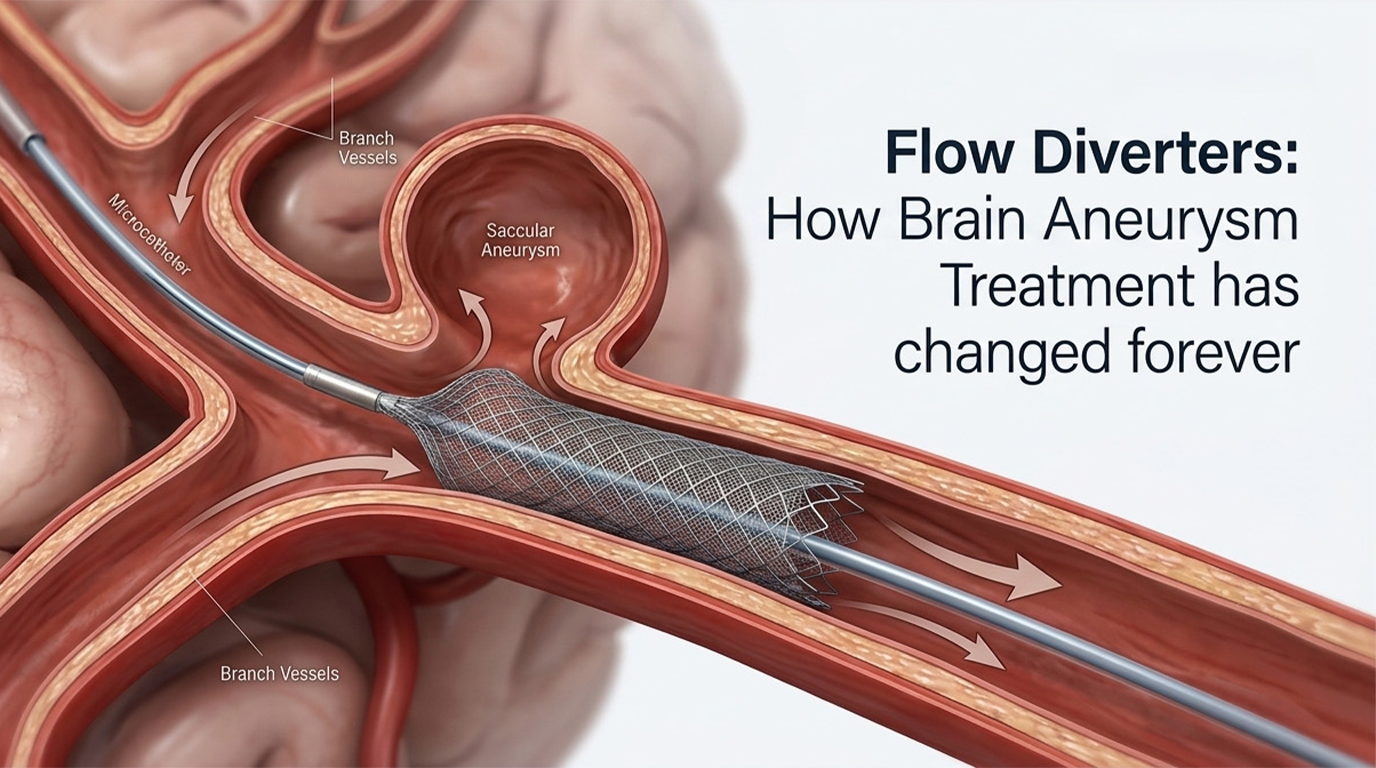
Figure 1. A flow diverter sits across the aneurysm's neck rather than inside the sac, redirecting flow along the parent vessel.
The Pipeline Embolization Device earned its original approval for large and giant unruptured internal carotid artery aneurysms — the cases where clipping was hazardous and coiling recurred.
It worked well enough and safely enough that clinicians began asking an obvious question:
"Why stop there?"
The Literature Answers in Four Directions
Over the past several years, research has pushed flow diversion well beyond its original indication. The expansion runs along four distinct lines.
Small and Medium-Sized Anterior Circulation Aneurysms
Once considered too modest to justify a flow-diverting stent, these are now routinely treated with flow diverters, including with the newer lattice-design devices purpose-built for smaller vessel calibers.
Posterior Circulation Aneurysms
Vertebrobasilar lesions, carrying a higher baseline rupture risk, were historically the domain of high-morbidity microsurgery. They are now treated by flow diversion, even in locations comparable to the original Pipeline indications. A growing body of meta-analysis work, including recent University of Iowa-led research, has refined data on which posterior circulation morphologies respond best.
Ruptured Aneurysms
Once considered an outright contraindication because of the antiplatelet therapy that flow diverters require, ruptured aneurysms are now treated off-label in select cases where clipping or coiling isn't feasible.
Traumatic and Dissecting Aneurysms
Irregular, non-saccular lesions that don't have a clean "neck" for a clip or a coil to work with have become a niche for flow diverters. In such cases, the flow diverter's job of reconstructing the vessel wall, rather than packing the aneurysm sac, is arguably a better structural fit than the tools it replaced.
Why Does This Matter?
For clinicians, the through-line is that flow diverters are no longer a last-resort device for anatomically difficult carotid aneurysms. They are a first-line consideration across a much wider anatomical and clinical range, provided that antiplatelet management and case selection are handled carefully.
The last caveat matters for patient safety and better procedural outcomes, because expanded indications don't mean expanded tolerance for error. Posterior circulation cases still carry real thrombo-embolic risk, and when managing a ruptured aneurysm, the clinician still needs to balance bleeding risk against the antiplatelet regimen the device demands.
For informed patients, the practical takeaway is simpler: if you or a family member has been told an aneurysm is "not a good candidate for clipping or coiling," that sentence carries less finality than it used to. Today, flow diverters have closed a gap in the device category that, fifteen years ago, had a very narrow lane.
This article is intended for general education purposes only and does not provide medical advice or replace medical evaluation and individualized clinical advice.
References
SurgeonsLab's educational articles are based on evidence-backed information and reviewed against published clinical and regulatory sources to help ensure accuracy and up-to-date reliability.
View Sources
- Zhou, Yu et al. “Editorial: New insights into the treatment of aneurysms with flow diverters: novel indications and therapeutic advances.” Frontiers in Neurology vol. 14 1232777. 14 Sep. 2023, doi:10.3389/fneur.2023.1232777. pmc.ncbi.nlm.nih.gov/articles/PMC10539548
- Thomas, Ajith J., and Christopher S. Ogilvy. “Flow Diversion for Intracranial Aneurysm Treatment.” Neurosurgery, vol. 86, no. Supplement_1, Dec. 2019, S1-S2, doi:10.1093/neuros/nyz412. www.ovid.com/10.1093/neuros/nyz412
- Adeeb, Nimer et al. “Expanding the Indications for Flow Diversion: Treatment of Posterior Circulation Aneurysms.” Neurosurgery vol. 86, Suppl 1 (2020): S76-S84. doi:10.1093/neuros/nyz344. pubmed.ncbi.nlm.nih.gov/31838535
- Brito, Anderson et al. “Flow diversion for posterior circulation intracranial aneurysms: a systematic review and meta-analysis.” Journal of Neurointerventional Surgery vol. 18,3 773-781. 16 Feb. 2026, doi:10.1136/jnis-2025-023190. pubmed.ncbi.nlm.nih.gov/40268406
- Ma, Yuanjin et al. “Lattice flow diverter for the treatment of small and medium-sized anterior circulation aneurysms.” Frontiers in Neurology vol. 17 1729763. 20 Jan. 2026, doi:10.3389/fneur.2026.1729763. pmc.ncbi.nlm.nih.gov/articles/PMC12864136
- Brouillard, Adam M et al. “The Use of Flow Diversion for the Treatment of Intracranial Aneurysms: Expansion of Indications.” Cureus vol. 8,1 e472. 28 Jan. 2016, doi:10.7759/cureus.472. pmc.ncbi.nlm.nih.gov/articles/PMC4772997
Train Flow Diversion Across Every Indication
As flow diverter indications expand into posterior circulation, ruptured, and traumatic aneurysms, procedural teams need to rehearse deployment across a wider range of anatomy. SurgeonsLab's reusable and patient-specific models let teams practice device positioning, wall apposition, and case selection before it matters in the angio suite.
Request a demonstration Upload DICOM dataFrequently Asked Questions
How does a flow diverter differ from clipping or coiling?
Clipping and coiling both work inside or directly on the aneurysm sac. A flow diverter is placed across the neck of the aneurysm, along the parent vessel, redirecting blood flow away from the sac so it thromboses over time as the vessel wall remodels over the device.
What was the original indication for flow diverters?
The Pipeline Embolization Device was originally approved for large and giant unruptured internal carotid artery aneurysms — cases where clipping was hazardous and coiling tended to recur.
Can flow diverters treat small aneurysms today?
Yes. Small and medium-sized anterior circulation aneurysms, once considered too modest for a flow-diverting stent, are now routinely treated, including with newer lattice-design devices built for smaller vessel calibers.
Are flow diverters used for ruptured aneurysms?
In select cases, yes, off-label, when clipping or coiling isn't feasible. This was once considered a contraindication because flow diverters require antiplatelet therapy, which must be carefully balanced against bleeding risk in a ruptured aneurysm.
Does an expanded indication mean less risk?
No. Expanded indications don't mean expanded tolerance for error. Posterior circulation cases still carry real thrombo-embolic risk, and careful case selection and antiplatelet management remain essential regardless of anatomy.
What does this mean if I've been told my aneurysm isn't a good candidate for clipping or coiling?
It carries less finality than it used to. Flow diverters have closed a gap in the device category that, fifteen years ago, had a very narrow lane, and may be worth discussing with your care team as an option.