In the ever-expanding endeavor of surgical advancement, especially in the hyper-specific subspecialty of neurovascular intervention, effective training is no longer a choice but rather a necessity. For many years, traditional methods have been the mainstay of training, acting as a coarse interface between theory and practice. The more complex procedures, however, with their ever-increasing need for fine detail and accuracy, make the limitations of these methods more and more apparent.
In today's environment of ever-increasing complexity in the neurovascular field, SurgeonsLab explores the critical distinctions that our reusable liquid embolic Demonstrator brings to traditional training models.
The Landscape of Conventional Training Models: A Foundation with Limitations
Traditional training models are usually characterized by several classes, each accompanied by some advantages but, more importantly, by shortcomings.
- Cadaveric models: good anatomical fidelity, but limited by availability, price, and ethics — and they lack physiological flow. Tissue properties also change post mortem, reducing the fidelity of haptic feedback.
- Animal models: capable of generating live physiological responses, but they carry considerable ethical concerns, are expensive to maintain, and present anatomical and physiological differences from human cases.
- Static plastic or silicone models: widely available and affordable for basic anatomical learning, but with no dynamic flow or realistic haptic feedback, and no way to simulate embolic agents — limiting their use for sophisticated procedural training.
- Single-use flow models: add flow and dynamism, but are costly to produce. High cost per session makes repeated practice prohibitively expensive and creates waste due to limited reuse.
Although effective in the past, these standard techniques are often not sufficient to generate the realistic, reproducible, and physiologically precise environment needed to learn advanced neurovascular embolization procedures. Trade-offs typically have to be made between realism, sustainability, and affordability.
For a deeper look at the platform referenced throughout this article, see our companion guide, The Comprehensive Guide to the Reusable Liquid Embolic Demonstrator.
Introducing the Reusable Liquid Embolic Demonstrator
Our Reusable Liquid Embolic Demonstrator breaks these conventional constraints purposefully. Through materials science expertise, cutting-edge fluid dynamics, and thoughtful design, we have developed a solution that is both incredibly realistic and affordable to train with over many iterations. The differentiating features fall into four areas.
Unparalleled Physiological Realism and Dynamic Flow
Unlike static models, our Demonstrator is designed to replicate the dynamic environment of the human vasculature.
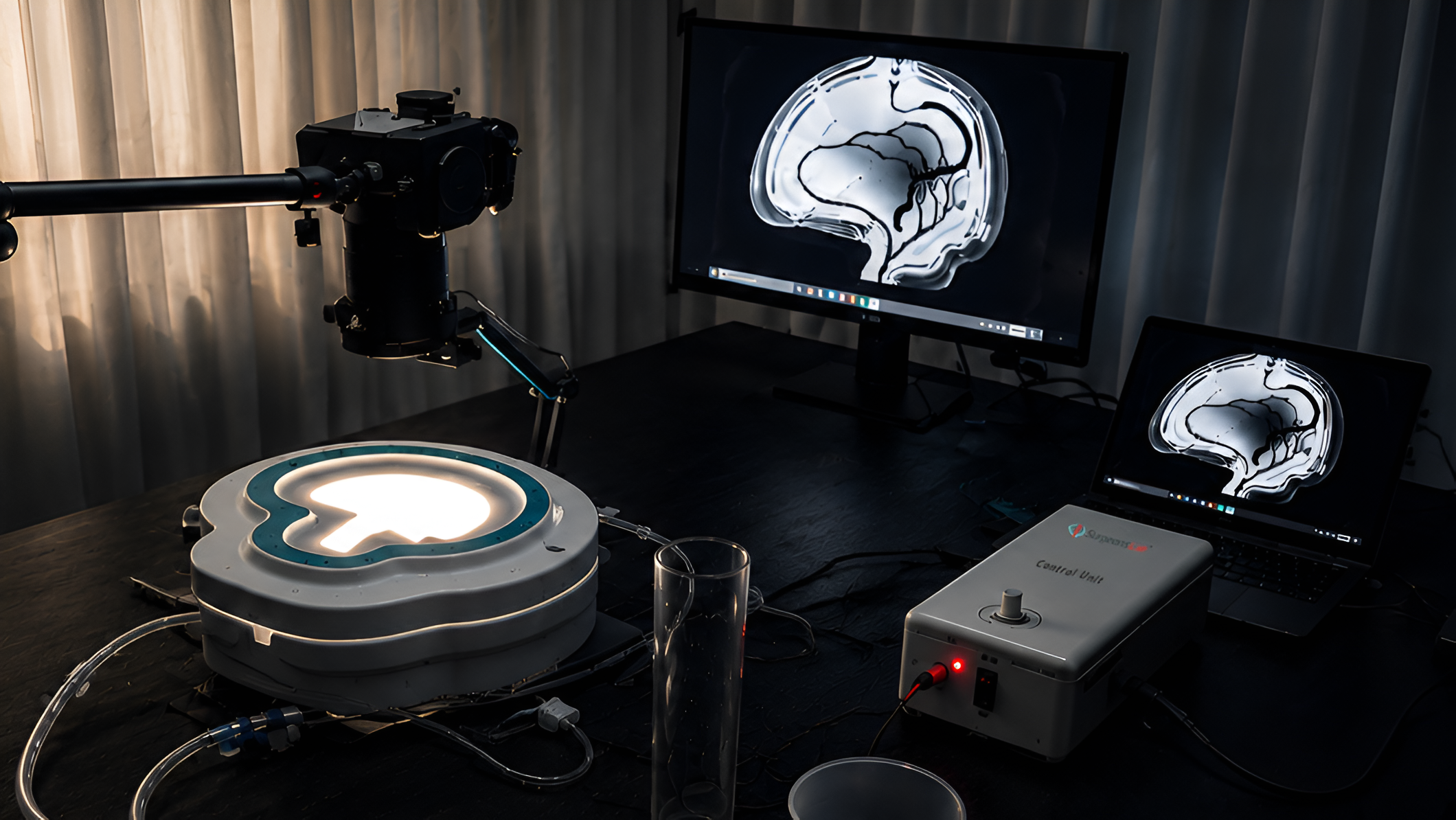
- Pulsatile blood flow: a combined perfusion system simulates the dynamic pulsatile flow seen in vivo, training both catheter manipulation and stability, as well as the timing of embolic agent delivery, which is generally dictated by the cardiac cycle. Most conventional models do not mimic pulsatile blood flow.
- Broad fluid compatibility: the models are compatible with many clinically relevant embolic materials, including DMSO, nBCA, particles, and coils. Each material's rheological properties, polymerization rate, and handling characteristics are simulated, letting trainees practice in ways not possible with static or single-fluid models, while also supporting testing of new embolization devices.
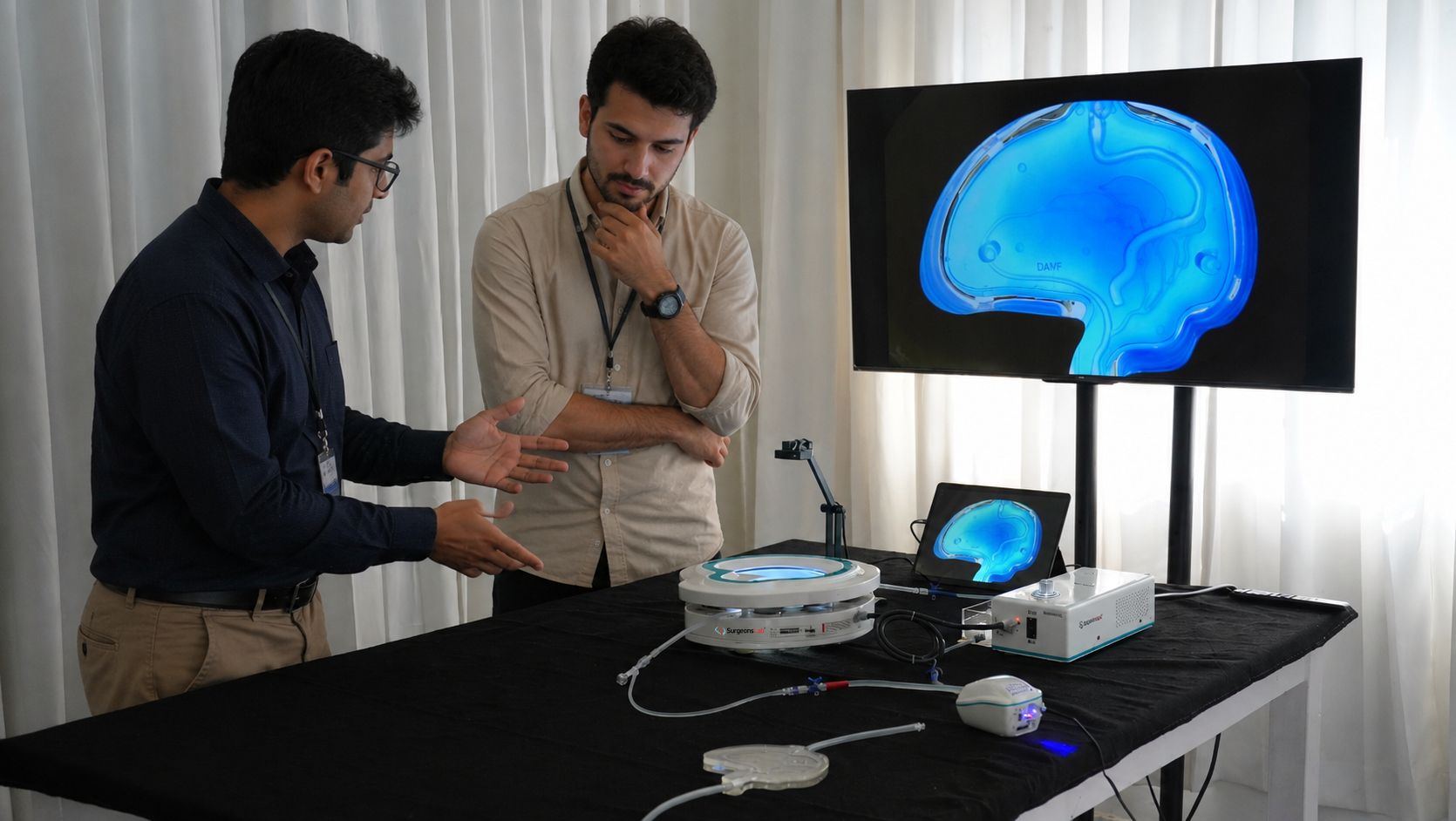
- Angio-compatibility: the Demonstrator operates seamlessly with fluoroscopy and other angio-imaging platforms, so trainees practice fluoroscopic guidance as they would in an interventional procedure suite — a major advantage over models where trainees had to "visualize" fluoroscopic images, which limited guided-procedure training.
Advanced Modularity and Multi-Pathology Versatility
General approaches commonly involve one anatomical representation or one set of conditions. In contrast, the reusable Demonstrator was designed to be inherently modular.
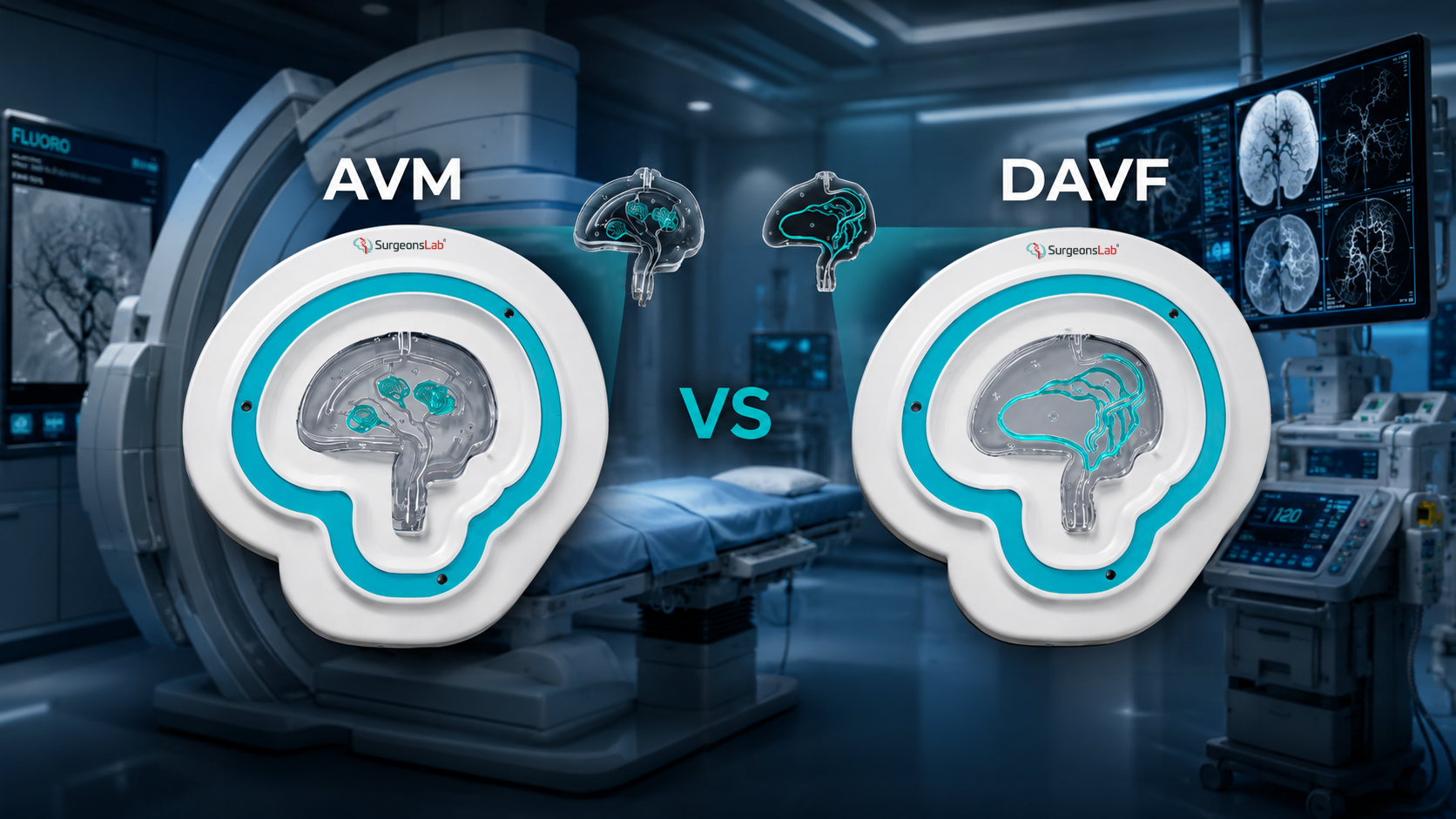
- Interchangeable models: the platform houses a large selection of specialized, replaceable models that exchange in seconds, tool-less — including AVM, DAVF (both high-flow and low-flow), MMA (above 1 mm, below 1 mm, Y-shape, and retrograde variants), and tumours, all on one Demonstrator base.
- Realistic anatomical replication: models are carefully constructed to recreate detailed vascular structures, from the complex AVM nidus to the finer connections in DAVFs, letting trainees experience the precise anatomic features they'll encounter in practice.
- Varying lesion sizes: vascular lesions are available both smaller and larger than 1 mm, allowing trainees to acquire the micro-catheterization skills needed to enter ultra-small, tortuous vessels — something conventional models can't support.
The Electromagnetic Fixation System: A Leap in Usability and Durability
The most innovative aspect of our system is the use of electromagnetic fastening, which directly overcomes the primary inconvenience of existing flow models: securing segments reliably and consistently.
- Leak-proof and secure: magnetic elements hold the vessel model in place, ensuring a perfectly sealed, leak-free fit and avoiding the leaky, fluctuating flow seen with mechanical clamping in conventional models.
- Rapid interchangeability: magnetic fixation makes swapping vascular models quick and easy, letting instructors switch from one pathology to another — for example, AVM to DAVF — in a matter of seconds, maximizing training time across a multitude of cases.
- Enhanced durability: avoiding mechanical loading means sensitive vessel models aren't subjected to repeated wear, extending the platform's lifespan.
Economic Sustainability and Reduced Environmental Impact
One of the biggest advantages of a reusable system is its cost and environmental benefit.
- Reduced cost per session: single-use systems can be realistic at first, but become extremely expensive to keep using since a new model is required every time. A reusable system with replaceable models significantly cuts the cost per training session, letting institutions practice more frequently.
- Minimized waste: reusability reduces the waste produced by single-use training models — an important consideration in today's healthcare setting.
- Long-term investment: a reusable solution requires investment in infrastructure that adapts and expands with future procedural techniques and pathologies, while a single-use or expendable option becomes outdated or used up within a short period.
"We've gone from inanimate and restricted to dynamic, adaptable, and cost-effective for well-trained neurovascular physicians of the 21st century."
Ending Remarks
What truly separates our Reusable Liquid Embolic Demonstrator from traditional training models is the extent of the paradigm shift it represents — from inanimate and restricted to dynamic, adaptable, and cost-effective training for the neurovascular physicians of today.
Through best-in-class physiology, disease variety and modularity, an entirely new electromagnetic fixation mechanism, and substantial cost benefits, we offer far more than an education tool — a holistic solution to neurovascular education on a whole new level.
Frequently Asked Questions
How does a reusable liquid embolic Demonstrator differ from traditional static anatomical models?
The reusable liquid embolic Demonstrator provides pulsatile, dynamic blood flow and the ability to use true embolic agents to simulate a realistic environment not attainable with a static anatomical model. With the Demonstrator, you interact in real time with blood flow and embolic agents, which is vital for becoming competent in neurovascular interventions.
What advantages does the electromagnetic fixation system offer over conventional clamping methods?
The electromagnetic fixation system provides an absolutely leak-proof and watertight seal, free of the leaks and irregular flow seen with conventional clamping. Models can also be interchanged very quickly without any tools, increasing training efficiency and extending model life.
Can the SurgeonsLab reusable Demonstrator be used for training on multiple neurovascular pathologies?
Yes, the system is highly modular. Different interchangeable models cover different pathologies, such as AVMs, DAVFs, and various MMA geometries, enabling training across different diseases within one system.
How does the reusability of the Demonstrator impact training costs and environmental sustainability?
Because the Demonstrator is both reusable and built around long-term models, the cost per training session is considerably lower than one-time model training. It also cuts down on waste, contributing to a more sustainable approach to training.
Is the SurgeonsLab reusable liquid embolic Demonstrator compatible with real-time imaging?
Yes, the Demonstrator is designed with full angio-compatibility and works with fluoroscopy and other angio-imaging devices to train candidates with true image guidance.